Patterns, Primes and Dynamics
Date: 27 June - 17 July 2027
Location: Park City Mathematics Institute
Event type: Extended Format
Organisers: Nikos Frantzikinakis (University of Crete); Bryna Kra (Northwestern University) Sarah Peluse (Stanford University); Florian Richter (EPFL); Joni Teräväinen (University of Cambridge)
Which arithmetic patterns must appear in a dense sets of integers? in the primes? in finite colorings of the integers? What forms of randomness emerge in the distribution of primes? What about in the behavior of multiplicative functions? These questions connect additive combinatorics, analytic number theory, and ergodic theory, and the interactions among these fields have transformed our understanding of order and randomness.
The 2027 Graduate Summer School at PCMI will introduce central themes and methods in these fields through nine closely interconnected minicourses, ranging from classical foundations to recent breakthroughs and open problems. Particular emphasis will be placed on how ideas from one area illuminate questions in another. Topics will include arithmetic patterns, Gowers norms and inverse theorems, structure and recurrence in dynamical systems, multiplicative functions and the Sarnak and Chowla conjectures, primes in short intervals, infinite additive configurations, and pointwise ergodic theorems along polynomials and primes.
The program welcomes graduate students beginning to explore these subjects as well as those seeking to broaden their research perspective.
Professor Vitaly Bergelson (Ohio State University) and Professor Peter Sarnak (Princeton University and Institute for Advanced Study) have been appointed as Clay Senior Scholars to participate in this program.
CMI Enhancement and Partnership Program
Commutative Algebra, Representation Theory, and Other Interactions
Simons Laufer Mathematical Sciences Institute
Singularities & PDEs Representing Natural Phenomena
Simons Laufer Mathematical Sciences Institute
Representation Theory Under the Influence of Quantum Field Theory
Simons Laufer Mathematical Sciences Institute
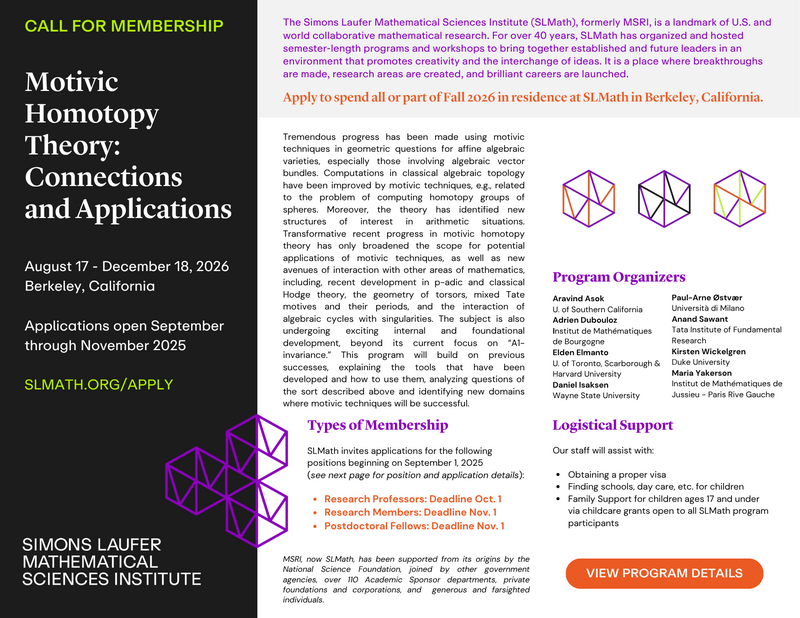
Motivic Homotopy Theory: Connections and Applications
Simons Laufer Mathematical Sciences Institute